

Quick Answer: What Are the Best Homework Strategies for Students in 2026?
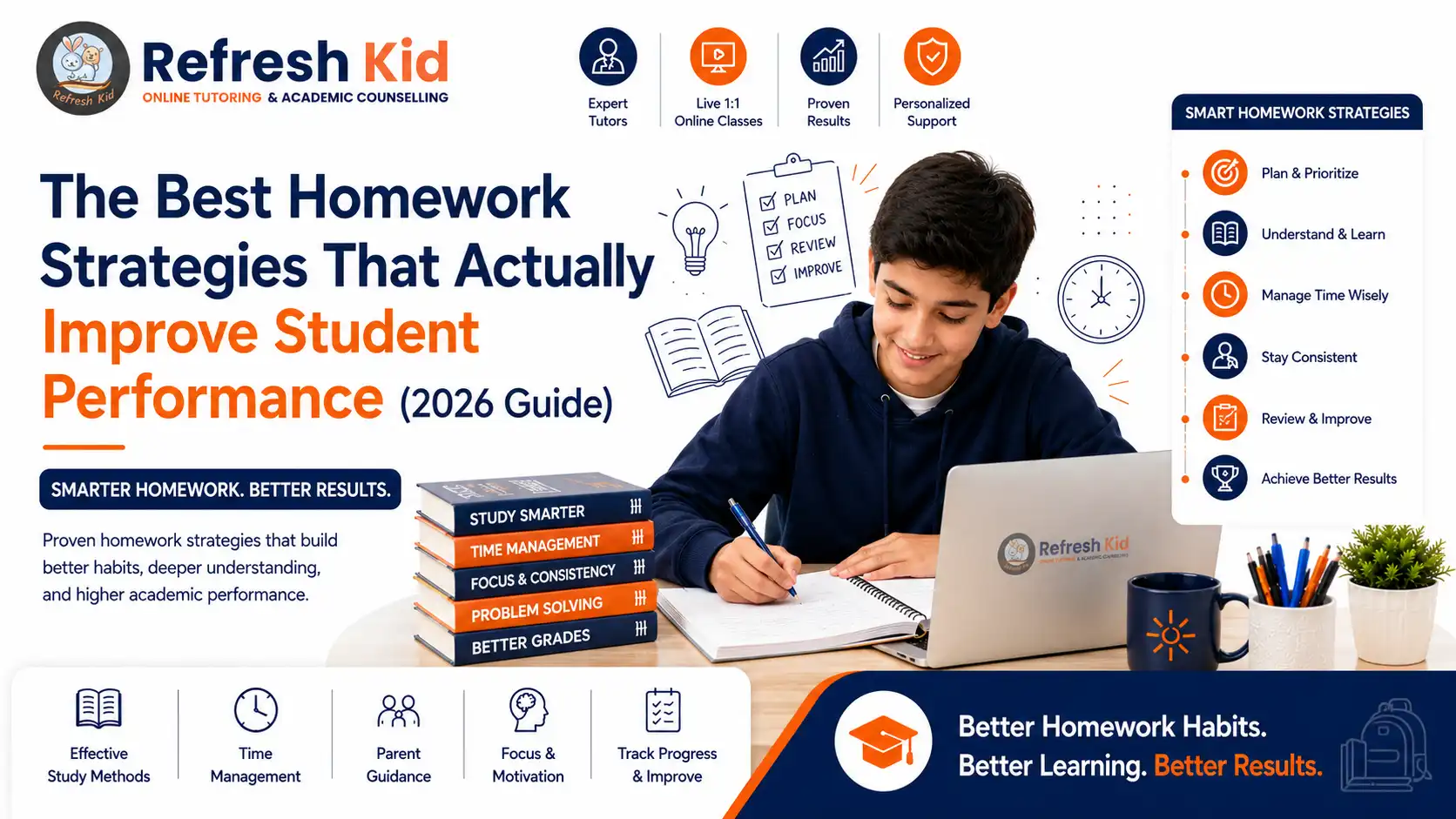
Students succeed at homework by working in the same place and time each day, starting with a quick review of what's due, breaking longer assignments into smaller chunks, removing phones and other distractions during work blocks, and checking off a simple homework checklist before calling it done. A predictable routine matters more than the number of hours spent at the desk.
For families who want live US-certified teachers, personalized readiness assessments, homework coaching, K-12 subject tutoring, and weekly parent reports, Refresh Kid is designed to help students build homework routines that actually stick.
Key Takeaways for Parents
- Good homework habits depend on a consistent routine, not on how much time is spent at the desk each night.
- Many students struggle with homework not because the work is too hard, but because of distractions and disorganized starts.
- Different age groups need different homework support. A second grader and a high schooler with four classes' worth of work are not managing the same routine.
- Homework strategies should evolve as a child moves from short, parent-supervised tasks into longer, independent assignments.
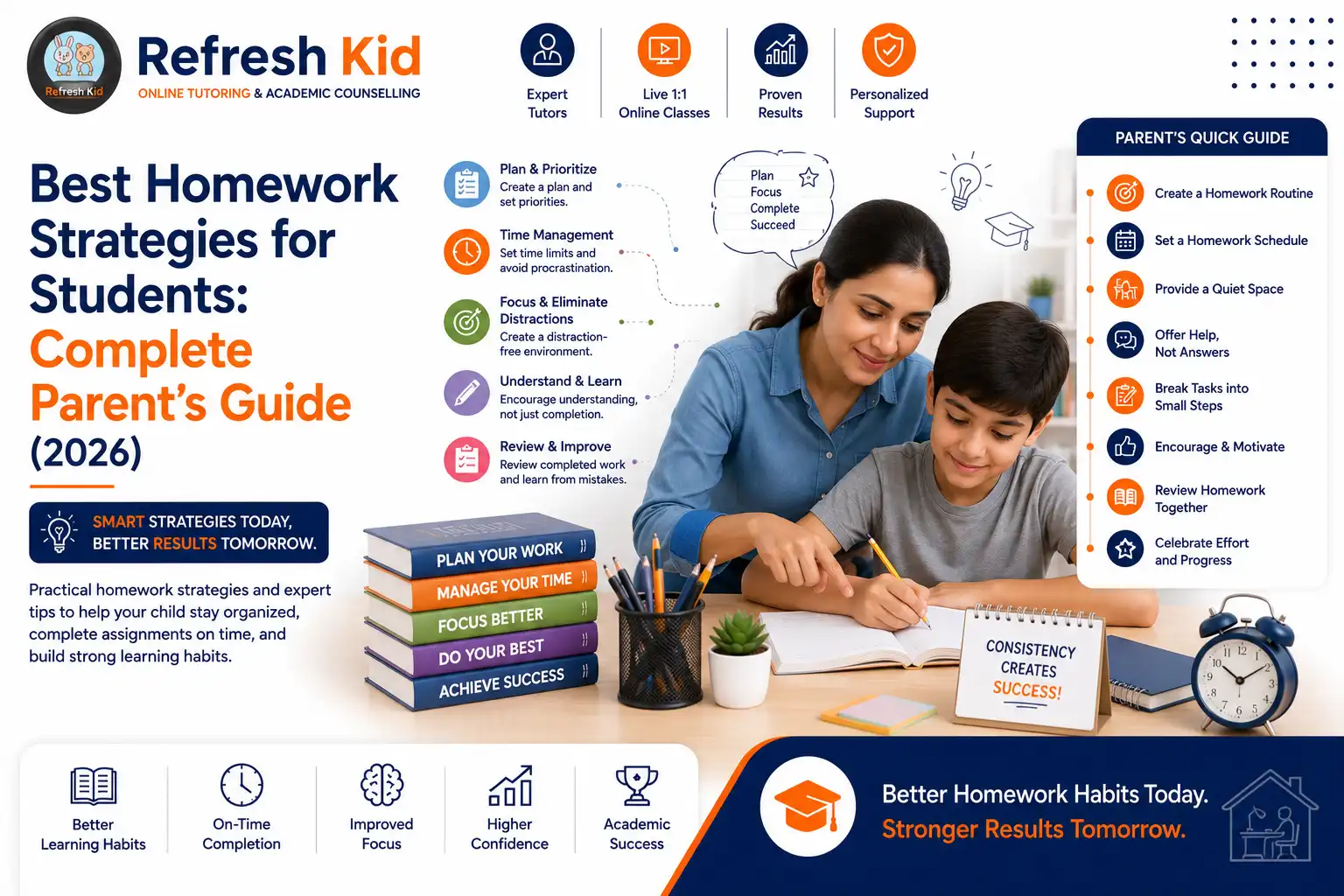
- Parent involvement should focus on structure and encouragement, not sitting over a child's shoulder or redoing the work.
Better Homework Habits Begin With a Better Routine
A consistent spot, a clear starting checklist, distraction-free blocks, and a simple way to track what's done make homework time calmer for everyone.
Why Most Homework Routines Fail
Parents often assume that setting a homework time on the calendar is enough to keep a child on track. In reality, a student can sit down at the same time every night and still get very little done, because the real issue is usually distractions and a disorganized start, not the schedule itself. Starting homework without knowing what's actually due, keeping a phone within reach, or jumping straight into the hardest assignment without a plan turns homework time into a source of friction instead of steady progress.
The strategies that actually work focus on how homework time is structured, not just when it happens. A student who spends two minutes listing what's due before starting will get through the work faster and with less frustration than a student who dives in without a plan.
Students Often Need Better Structure, Not More Supervision
In many families, the instinct is to hover over a child until homework is finished. But sitting over a child's shoulder without changing the underlying habits usually leads to dependence rather than independence. Parents should first ask: does my child know exactly what's due before sitting down, or are they figuring it out as they go? Is there a distraction-free space set aside, or is homework happening in front of a screen? Is the hardest assignment tackled first while focus is fresh, or left for last when energy is gone?
A strong homework routine helps families answer important questions: Is my child using a system that builds independence, or one that depends on constant reminders? Do they know which assignments matter most tonight, or is everything treated the same? Which subjects are creating the most homework friction? How do we know if the current routine is actually working?
Common Homework Struggles by Age Group
Homework challenges look different depending on a child's age and grade level. A strong parenting article should speak directly to the specific struggles families are facing at each stage.
| Age / Grade Level | Common Struggle | Best Strategy to Build |
|---|---|---|
| Elementary (K-5) | Gets distracted easily and forgets to bring home assignments | Simple checklist, parent-supervised short work blocks |
| Middle School (6-8) | Juggles homework from multiple teachers with no single tracking system | One homework list, subject-by-subject time blocks |
| High School (9-12) | Puts off longer assignments until the night before they're due | Starting the hardest subject first, breaking work into chunks |
| AP & Honors Students | Underestimating how long dense reading or problem sets will take | Realistic time estimates, prioritizing by deadline and difficulty |
Homework Support for Every Age
Refresh Kid supports K-12 students in building homework habits and confidence that lead to real, lasting improvement.
What an Effective Homework Routine Actually Looks Like
Many families try generic advice like "set a homework time" without a deeper routine. The difference between homework habits that actually stick and habits that just look organized is whether they include a distraction-free space and a clear starting checklist. Parents should look for consistency, the right level of independence, and a way to catch a rough night before it turns into a rough week.
1. A Consistent Homework Spot
Working in the same distraction-free space each day, rather than wherever is convenient, helps a student settle in and start faster.
2. A Quick Homework Checklist
Listing everything due before starting prevents the last-minute discovery of a forgotten assignment right before bed.
3. Removing Distractions Up Front
Phones, notifications, and background shows pulled away before starting keep a short assignment from turning into an hour-long task.
4. Matching Support to the Grade Level
A first grader just learning to bring homework home, a middle schooler juggling several subjects, and a junior with AP coursework all need different kinds of homework support.
Subject-Specific Homework Strategies That Actually Work
One of the biggest mistakes parents make is treating all homework the same way. A child who spends the same amount of time on every subject every night is not accounting for what actually takes longer or causes the most frustration. Each subject rewards a different kind of homework approach.
Building the right strategy for each subject early prevents homework battles later, especially once the workload increases in middle and high school.
| Subject / Area | Why Generic Homework Habits Fail | Best Homework Strategy |
|---|---|---|
| Math | Rushing through problem sets without checking work leads to repeated mistakes | Work a few problems, check answers, then continue in short bursts |
| Reading / ELA | Skimming assigned reading the night before leaves no time to reflect | Spread reading across several nights instead of one sitting |
| Science | Leaving lab write-ups until the last minute causes rushed, incomplete work | Start write-ups the same night as the lab while details are fresh |
| Writing / Essays | Starting and finishing a draft in one sitting leaves no room to revise | Separate homework blocks for outlining, drafting, and revising |
| Long-Term Projects | Treating a project as one big task until the deadline feels urgent | Break the project into weekly homework checkpoints |
Homework Strategy by Subject
The right approach changes depending on the subject and what's due.
Math
Short bursts with answer checks built in.
Reading
Spreading assignments across several nights.
Science
Starting write-ups the same night as the lab.
Writing
Separate blocks for outlining, drafting, revising.
Projects
Weekly checkpoints instead of one deadline.
Checklist
A quick list of everything due before starting.
Avoiding Distractions During Homework Time
Getting homework done well is not only about which subject comes first. Focus and distraction management determine whether a good routine is actually followed once real life gets busy. Students who work in short, phone-free blocks tend to finish faster and retain more than students who try to power through with constant interruptions.
The students who struggle least with homework usually work in a consistent spot, keep phones and notifications out of reach, and take short breaks between subjects instead of one long, unbroken stretch.
| Grade | Recommended Work Block Length | Distraction-Management Strategy |
|---|---|---|
| Elementary (K-5) | 15 to 20 minutes per session | Parent-supervised space with no screens nearby |
| Middle School (6-8) | 20 to 25 minutes per session | Phone in another room, short breaks between subjects |
| High School (9-12) | 25 to 35 minutes per session | Notifications off, hardest subject tackled first |
| AP & Honors Students | 35 to 45 minutes per session | Dedicated distraction-free block with a set stopping point |
Grade-by-Grade Homework Roadmap
Homework routines should evolve as a child grows. A checklist that works for a second grader will not serve a junior handling four subjects' worth of work each night. Building the right structure at the right stage prevents students from starting each year further behind on homework habits than the last.
For students aiming at strong academic outcomes, the foundation begins earlier than many families realize. Routine, focus, and checklist habits built in elementary and middle school directly affect how easily a student adapts to heavier homework loads later on.
Homework Roadmap by Stage
- Elementary school: Build simple checklist habits, short supervised work blocks, and a consistent homework spot.
- Middle school: Introduce a single homework list, subject-by-subject time blocks, and reduced screen access during work time.
- Early high school: Develop task breakdown skills, starting with the hardest subject, and consistent nightly checklists.
- Junior year: Connect homework routines directly to heavier reading loads and problem sets from AP or honors courses.
- Senior year: Shift toward fully self-managed homework routines that require little parent prompting.
Homework Growth Roadmap
From simple checklist habits through independent, distraction-free routines.
Elementary
Simple checklists and supervised work blocks.
Middle School
One homework list and reduced screen time.
Early High School
Task breakdown and nightly checklists.
Junior Year
Routines built around AP and honors workload.
Senior Year
Fully self-managed homework routines.
Independent Homework vs. Guided Support
Independent homework works well once a student has already built strong habits: checklists, distraction management, and subject-specific pacing. But for students still developing these habits, unguided homework time often leads to distractions, incomplete work, and rising frustration. For busy families, guided support can build the right process faster.
| Factor | Guided Homework Support | Unguided Independent Homework |
|---|---|---|
| Accountability | Built-in through regular sessions | Depends entirely on the student |
| Identifying subject struggles | Immediate, expert-guided assessment | Often overlooked until grades slip |
| Consistent homework habit | Modeled and reinforced by a teacher | Easy to skip on busy or tiring nights |
| Parent visibility | Weekly reports and check-ins | Varies, often unclear |
| Subject-specific pacing | Taught explicitly by a teacher | Often generic across all subjects |
Homework Checklist for Parents
Routine
- Is there a consistent time and place for homework each day?
- Is the hardest subject being tackled first while focus is fresh?
- Are distractions removed before starting, not during?
Planning
- Is a quick checklist made of everything due before starting?
- Are longer assignments broken into smaller chunks in advance?
- Are upcoming tests or projects already on the radar?
Distractions
- Is the phone out of reach during homework time?
- Are notifications and background screens turned off?
- Is there a short break planned between subjects instead of one long stretch?
Parent Involvement
- Is support focused on structure rather than doing the work for them?
- Does the child feel comfortable asking for help when stuck?
- Is the child gradually taking more ownership of their own homework routine?
Why Families Choose Refresh Kid to Build Better Homework Habits
Refresh Kid supports K-12 students online with a structure that turns chaotic homework nights into manageable ones. Instead of guessing what to prioritize, families get a plan built around the student's grade level, subjects, and goals, guided by a live teacher who tracks progress every week.
Live US-Certified Teachers
Students work with real teachers who identify homework habits that aren't working and rebuild them with proven strategies.
Weekly Parent Reports
Parents receive clear updates on what was completed, which habits improved, and what still needs attention.
Subject-Specific Coaching
Refresh Kid tailors homework support to each subject, from math practice to reading assignments and essay drafts.
Distraction-Aware Routines
Students learn to work in focused, phone-free blocks that get homework done faster with less frustration.
K-12 Coverage
Families can build homework routines for elementary foundations, middle school organization, and high school independence in one place.
3,000+ Students Served
Refresh Kid has supported thousands of students with over 900,000 learning hours across K-12 subjects.
Frequently Asked Questions
The most effective approach combines a consistent homework spot and time, a quick checklist of what's due, removing distractions before starting, breaking longer assignments into chunks, and starting with the hardest subject first.
This usually happens because of distractions or an unclear starting point, not the difficulty of the work itself. Removing phones and screens and starting with a quick checklist often speeds things up significantly.
Most families benefit from shorter, supervised sessions for younger students and longer, more independent blocks as a child moves into middle and high school. Long, unbroken stretches tend to reduce focus rather than help.
For younger children, light supervision helps build the habit. For older students, it's more effective to check in at the start and end rather than sitting over their shoulder the whole time, which can create dependence.
Yes. Refresh Kid teachers assess where a student stands, including homework habits, focus, and subject-specific struggles, so students build both subject mastery and lasting homework routines.
Absolutely. Strong students often use better homework routines to get through heavier AP or honors workloads faster and with less stress, freeing up time for other activities. Better habits aren't only for students who are struggling.
A consistent time, place, and starting checklist reduce friction more than reminders or pressure. Predictability tends to lower resistance more than repeated prompting.
The most common mistake is stepping in to do the work rather than helping build the routine. Teaching a student to plan, check their own work, and manage distractions pays off far more than finishing the assignment for them.
Ask whether the tutor starts with an assessment rather than guessing, whether progress is reported weekly, whether the plan is customized by subject and grade level, and whether the approach adapts as the student moves up in school.
Families can visit www.refreshkid.com to request a free demo class or academic assessment for their child.
Ready to Build a Homework Routine That Actually Works?
Whether your child needs a homework reset, a distraction-free routine, or a structured system to stay on top of assignments, Refresh Kid helps families succeed with live US-certified teachers and clear weekly parent communication.