

Quick Answer: How Can I Help My Child Improve Reading Comprehension in 2026?
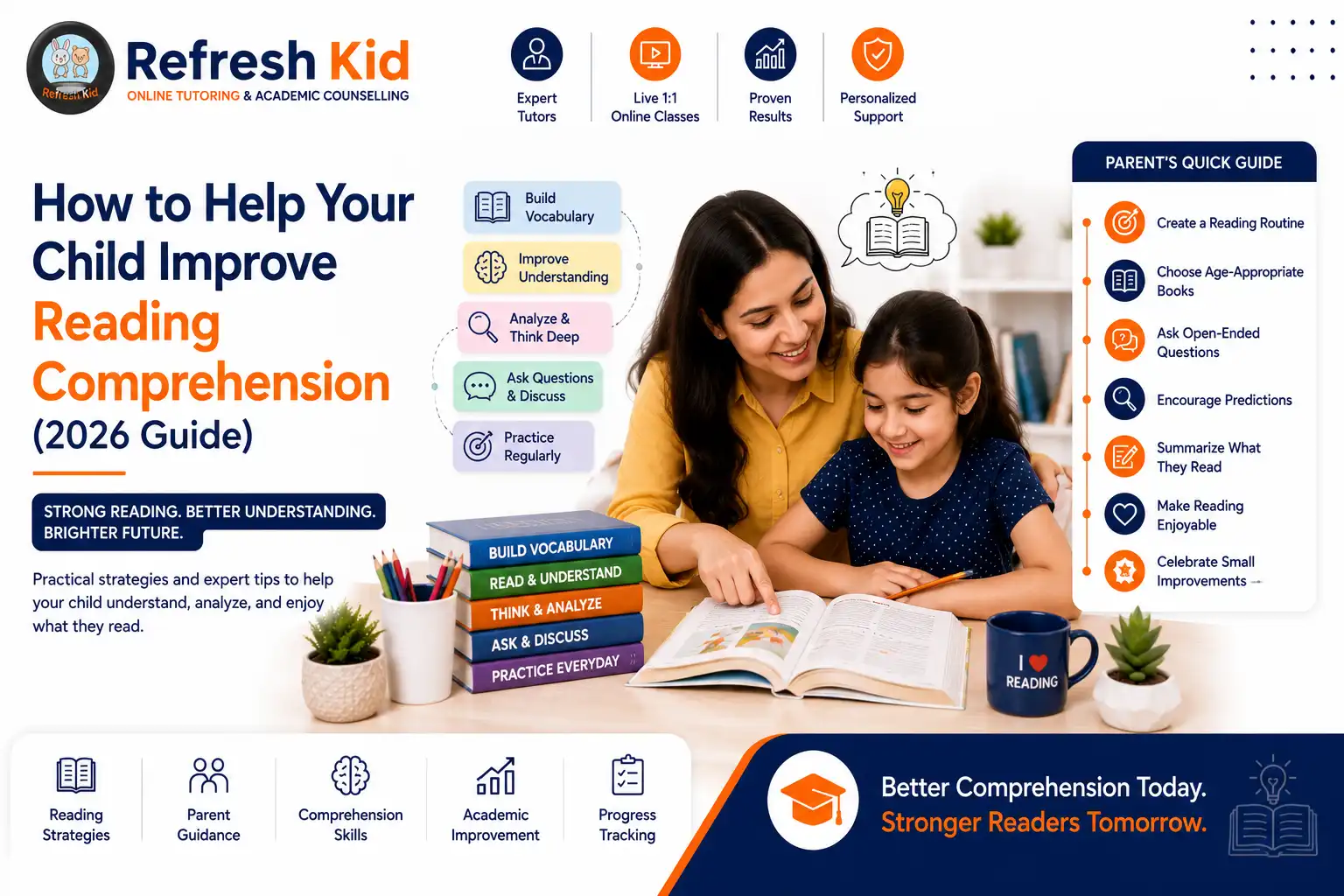
Children improve reading comprehension by reading a little every day instead of cramming long sessions in occasionally, pausing to ask questions about what they just read, connecting new vocabulary to words they already know, summarizing each section in their own words, and rereading tricky passages instead of skipping past them. Comprehension grows fastest when reading is active, not passive.
For families who want live US-certified teachers, personalized reading assessments, guided practice in fluency and vocabulary, K-8 subject tutoring, and weekly parent reports, Refresh Kid is designed to help students build reading comprehension skills that carry over into every subject.
Key Takeaways for Parents
- Reading comprehension is a skill that can be trained, not a fixed trait some children simply have and others don't.
- Many children who decode words fine still struggle to understand or remember what they read.
- Different age groups need different comprehension priorities. A second grader and a sixth grader are not building the same skills.
- Comprehension strategies should evolve as a child moves from picture books into chapter books, nonfiction, and multi-step assignments.
- Parent involvement should focus on conversation and consistency, not correcting every mistake mid-sentence.
Better Comprehension Begins With Active Reading
Questioning, connecting, summarizing, and rereading turn reading time into real understanding instead of just page-turning.
Why Most Reading Comprehension Strategies Don't Stick
Parents often assume that if a child can sound out words correctly, comprehension will follow naturally. In reality, a child can read every word on the page accurately and still walk away with almost nothing, because decoding and understanding are two separate skills. Handing a child a book without any follow-up conversation, letting them skim past confusing sentences, or only checking comprehension after a whole chapter turns reading into a habit that looks productive but isn't building real understanding.
The strategies that actually improve comprehension focus on what happens during reading, not just whether a book got finished. A child who pauses every page or two to explain what just happened will retain far more than a child who reads straight through without stopping.
Children Often Need Better Strategies, Not More Books
In many families, the instinct is to simply assign more reading time. But adding pages without changing how a child reads usually leads to the same shallow skimming, just for longer. Parents should first ask: is my child stopping to notice when something doesn't make sense, or reading past confusion? Can they retell the main idea in their own words, or only recall small details? Are they building vocabulary as they go, or skipping unfamiliar words entirely?
A strong comprehension plan helps families answer important questions: Is my child using strategies that build real understanding, or just finishing books? Do they know which type of text they're struggling with most, fiction, nonfiction, or multi-step instructions? Which skills, vocabulary, inference, or summarizing, need the most attention right now? How do we know if the current approach is actually working?
Common Reading Struggles by Age Group
Reading comprehension challenges look different depending on a child's age and grade level. A strong parenting article should speak directly to the specific struggles families are facing at each stage.
| Age / Grade Level | Common Struggle | Best Strategy to Build |
|---|---|---|
| Early Elementary (K-2) | Can sound out words but can't retell what a story was about | Picture-supported retelling, parent-led questions after each page |
| Upper Elementary (3-5) | Struggles to move from short stories to longer chapter books | Chapter-by-chapter summarizing, vocabulary journals |
| Middle School (6-8) | Understands the plot but misses deeper themes or inferences | Guided discussion questions, annotating while reading |
Reading Comprehension Support for Every Age
Refresh Kid supports K-8 students in building fluency, vocabulary, and comprehension skills that carry across every subject.
What Effective Reading Comprehension Support Actually Looks Like
Many families try generic advice like "read more" without a deeper strategy. The difference between reading habits that actually build comprehension and reading habits that just look productive is whether they include active questioning and an honest check of what the child actually understood. Parents should look for consistency, the right level of challenge, and a way to catch confusion before it piles up across chapters.
1. Asking Questions Before, During, and After
Predicting what might happen, checking in mid-chapter, and reflecting afterward keeps a child actively thinking instead of passively turning pages.
2. Building Vocabulary in Context
Pausing on unfamiliar words and connecting them to something already known helps a child understand harder texts without losing the thread of the story.
3. Summarizing in Their Own Words
Retelling a passage without looking at the book reveals whether a child truly understood it or was just recognizing words on the page.
4. Matching the Text to the Grade Level
A kindergartner learning to retell a picture book, a fourth grader tackling a first chapter book, and a middle schooler analyzing theme all need different kinds of support.
Skill-Specific Reading Strategies That Actually Work
One of the biggest mistakes parents make is treating all reading the same way, whether it's a picture book, a nonfiction article, or a set of multi-step directions. A child who reads everything at the same pace and with the same approach is not accounting for what actually requires closer attention. Each reading skill rewards a different kind of strategy.
Building the right approach for each skill area early prevents comprehension gaps later, especially once texts get longer and more complex in middle school.
| Skill Area | Why Generic Reading Fails | Best Strategy |
|---|---|---|
| Vocabulary | Skipping unfamiliar words causes whole sentences to lose meaning | Pause, guess from context, then confirm the definition |
| Fluency | Choppy, word-by-word reading leaves little attention for meaning | Repeated reading of the same short passage to build smoothness |
| Inference | Taking every sentence literally misses the author's implied meaning | Ask "what does this tell us that isn't directly stated?" |
| Summarizing | Retelling every detail instead of the main idea overwhelms memory | Practice one-sentence summaries after each section |
| Nonfiction / Informational Text | Reading it like a story misses headings, charts, and text features | Preview headings and visuals before reading the full passage |
Strategy by Reading Skill
The right approach changes depending on the type of text and what's tripping the child up.
Vocabulary
Guess from context, then confirm meaning.
Fluency
Repeated reading builds smoothness and pace.
Inference
Reading between the lines, not just the words.
Summarizing
One-sentence main ideas after each section.
Nonfiction
Previewing headings, charts, and captions first.
Discussion
Talking through a book out loud with an adult.
Building Consistent Reading Habits That Actually Improve Comprehension
Improving comprehension is not only about which book is chosen. Consistency and how reading time is structured determine whether a good strategy is actually followed once real life gets busy. Children who read in short, focused sessions with a clear purpose tend to understand more than children who read in long, unstructured stretches.
The students who improve fastest usually read a little every day, talk about what they read with an adult, and reread confusing passages instead of pushing through them.
| Grade | Recommended Reading Session Length | Comprehension Strategy |
|---|---|---|
| Kindergarten - Grade 1 | 10 to 15 minutes per session | Picture-supported retelling with a parent asking simple questions |
| Grade 2-3 | 15 to 20 minutes per session | Pause-and-predict questioning, simple vocabulary journals |
| Grade 4-5 | 20 to 30 minutes per session | Chapter summaries, discussing character motivations |
| Middle School (6-8) | 25 to 35 minutes per session | Annotating text, discussing theme and inference |
Grade-by-Grade Reading Roadmap
Reading comprehension strategies should evolve as a child grows. An approach that works for a kindergartner will not serve a sixth grader analyzing a novel's theme. Building the right skills at the right stage prevents students from hitting a wall when texts suddenly get longer and more complex.
For students aiming at strong academic outcomes, the foundation begins earlier than many families realize. Vocabulary, fluency, and questioning habits built in early elementary directly affect how easily a student handles dense textbooks and multi-step assignments later on.
Reading Roadmap by Stage
- Kindergarten - Grade 1: Build phonics fluency, simple retelling, and picture-supported comprehension.
- Grade 2-3: Introduce chapter books, pause-and-predict questioning, and early vocabulary journals.
- Grade 4-5: Develop chapter summarizing, character analysis, and nonfiction text features.
- Grade 6-7: Connect comprehension to inference, theme, and annotating while reading.
- Grade 8: Shift toward independent analysis that prepares students for high school level texts.
Reading Growth Roadmap
From phonics and picture books through independent, analytical reading.
Early Elementary
Phonics fluency and picture-supported retelling.
Lower Elementary
Chapter books and pause-and-predict questions.
Upper Elementary
Chapter summaries and character analysis.
Middle School
Inference, theme, and annotating text.
Pre-High School
Independent, analytical reading habits.
Independent Reading vs. Guided Support
Independent reading works well once a child has already built strong habits: questioning, summarizing, and vocabulary strategies. But for children still developing these habits, unguided reading time often leads to skimming, missed details, and stalled progress. For busy families, guided support can build the right habits faster.
| Factor | Guided Reading Support | Unguided Independent Reading |
|---|---|---|
| Comprehension checks | Built-in through regular discussion | Depends entirely on the child noticing gaps |
| Identifying skill gaps | Immediate, expert-guided assessment | Often overlooked until grades slip |
| Consistent reading habit | Modeled and reinforced by a teacher | Easy to skip on busy days |
| Parent visibility | Weekly reports and check-ins | Varies, often unclear |
| Text-specific strategies | Taught explicitly by a teacher | Often generic across all text types |
Parent Checklist: Building Reading Comprehension
Routine
- Is there a consistent daily reading time in place?
- Is reading being paused for questions instead of read straight through?
- Are distractions minimized during reading time?
Skills
- Can the child retell the main idea in their own words?
- Are new vocabulary words being tracked and discussed?
- Can the child explain ideas that are implied, not just stated directly?
Text Selection
- Is the book at the right challenge level, not too easy or too hard?
- Is nonfiction being previewed before reading in full?
- Is there a mix of fiction and informational text?
Long-Term Confidence
- Does the reading strategy evolve as the child moves up in grade level?
- Is comprehension connected to schoolwork across other subjects?
- Is the child gradually reading and reflecting more independently?
Why Families Choose Refresh Kid to Build Better Reading Comprehension
Refresh Kid supports K-8 students online with a structure that turns passive page-turning into active, engaged reading. Instead of guessing which skills need work, families get a plan built around the student's grade level, current reading level, and goals, guided by a live teacher who tracks progress every week.
Live US-Certified Teachers
Students work with real teachers who identify comprehension gaps and rebuild them with proven reading techniques.
Weekly Parent Reports
Parents receive clear updates on what was read, which skills improved, and what still needs attention.
Skill-Specific Coaching
Refresh Kid tailors reading support to each skill area, from vocabulary and fluency to inference and summarizing.
Fiction and Nonfiction Practice
Students build strategies for stories, informational text, and multi-step instructions alike.
K-8 Coverage
Families can build reading foundations in early elementary through analytical reading habits by middle school in one place.
3,000+ Students Served
Refresh Kid has supported thousands of students with over 900,000 learning hours across K-12 subjects.
Frequently Asked Questions
The most effective approach combines daily short reading sessions, pausing to ask questions, connecting new vocabulary to known words, summarizing in the child's own words, and rereading confusing passages. Reading more pages without these habits rarely builds real understanding.
This is common and usually means decoding has outpaced comprehension. Children who read words accurately but skip actively thinking about meaning benefit from pausing regularly to predict, question, and summarize what they've read.
Most families benefit from shorter sessions for younger children and gradually longer, more focused sessions as a child moves into upper elementary and middle school. Long, unbroken reading stretches tend to reduce focus rather than improve comprehension.
Not every word, but pausing on words that block overall meaning is worthwhile. Encouraging a child to guess the meaning from context first, then confirming it, builds vocabulary more effectively than stopping constantly.
Yes. Refresh Kid teachers assess where a student stands across fluency, vocabulary, and comprehension, so students build both foundational reading skills and higher-level understanding.
Absolutely. Strong readers often use comprehension coaching to move into more advanced texts, sharpen inference skills, and prepare for the denser reading demanded by middle and high school. Better comprehension isn't only for struggling readers.
Ask them to retell the main idea in their own words without looking at the page. If they can only recall isolated details or need to reread the text to answer, comprehension strategies likely need more practice.
The most common mistake is measuring progress by pages read instead of understanding gained. A shorter session with real discussion builds more comprehension than a long session read in silence.
Ask whether the tutor starts with a reading assessment rather than guessing, whether progress is reported weekly, whether strategies are customized by skill area and grade level, and whether the approach adapts as the student moves up in school.
Families can visit www.refreshkid.com to request a free demo class or academic assessment for their child.
Ready to Help Your Child Read With Real Understanding?
Whether your child needs stronger vocabulary, better fluency, or a structured system to build comprehension, Refresh Kid helps families succeed with live US-certified teachers and clear weekly parent communication.